Behnaz Farahi
Assistant Professor, MIT Media Lab
Behnaz Farahi 是一位設計師、創意科技專家,現任麻省理工學院媒體實驗室助理教授,並領導該實驗室的「關鍵物質研究小組(Critical Matter Research Group)」。她受過建築訓練,致力於透過新興科技探索人體與空間之間的共感關係,研究焦點涵蓋女性主義、情感與社會互動。她的專業領域包括運算設計、互動媒體與數位製造。
Farahi 的作品屢獲殊榮,並曾在國際重要展覽中展出,包括林茲電子藝術節(Ars Electronica)、邁阿密 Context 藝術博覽會、洛杉磯 A+D 建築與設計博物館等,也被《WIRED》、《BBC》、《衛報》等媒體報導。她曾與 Adidas、Autodesk 以及 NASA 的火星居住3D列印研究計畫合作。
此外,她也是《Architectural Design》期刊專題《3D Printed Body Architecture》與《Interactive Design: Towards a Responsive Environment》的共同編輯。
Behnaz Farahi is a designer, creative technologist, and Assistant Professor at the MIT Media Lab, where she leads the Critical Matter Research Group. Trained as an architect, she explores empathy between the human body and space through emerging technologies, focusing on feminism, emotion, and social interaction. Her expertise spans computational design, interactive media, and digital fabrication. Farahi’s award-winning works have been exhibited internationally at Ars Electronica, Context Art Miami, and the A+D Museum, and are featured in outlets such as WIRED, BBC, and The Guardian. She has collaborated with Adidas, Autodesk, and NASA research projects on robotic 3D printing for extraterrestrial habitats.She is a co-editor of an issue of AD, ‘3D Printed Body Architecture’ and ‘Interactive Design: Towards a Responsive Environment’.
如果建築能夠感受、傾聽,並分享我們最私密的掙扎與希望會如何?
《凝望群星》將 MIT 的 大圓頂(Great Dome)——這座象徵制度性知識的標誌性建築——轉化為一個承載社群故事的載體,引領人們將目光投向城市。作品靈感來自校訓 per ardua ad astra(「艱難通往群星」),將圓頂重新想像為一塊「有生命的畫布」,映照的不僅是 MIT 所孕育的願景,更是其背後的韌性、脆弱,以及未被說出口的失敗與轉化的故事。
透過「凝視拼圖」——編織於公眾分享中的生命經驗——作品提出疑問:凝視是否能被重新奪回?不再是監視或控制,而是成為脆弱、關懷與同理的開端。
超過 200 位參與者進入特製的感官艙,在此與化身為圓頂的 AI 聲音對話,分享夢想、恐懼與渴望。他們的眼球運動與口述證言被記錄下來,每個故事的摘要同時以 布拉耶點字與參與者眼睛的特寫影像呈現。2025 年 3 月的三個夜晚,這些影像被投影映射於 寬 100 公尺的圓頂,並進行全球直播,讓建築轉化為一個公民敘事的平台,觀眾能即時解讀這些訊息。
在現場展演之外,作品網站亦提供互動數據視覺化,揭示這些情感證言的模式與連結,將個人情感轉化為集體的公民存在。藉由設計、AI 與參與式藝術的交織,《凝望群星》將「凝視」重新定義為一種集體的同理行動,使建築不再只是靜態地標,而是積極參與人類連結的主體。
年份: 2025
媒材: 投影映射、電腦視覺、麥克風、喇叭、3D 列印感官艙
尺寸: MIT 大圓頂:寬 100 公尺 × 高 54 公尺
What if architecture could feel, listen, and share our most intimate expressions of struggle and hope? Gaze to the Stars transforms MIT’s Great Dome, an iconic symbol of institutional knowledge, into a vehicle for empowering communities to share their stories and turn their eyes toward the city. Inspired by the motto per ardua ad astra—“through difficulties to the stars”—this project reimagines the Dome as a living canvas, reflecting not only the aspirations of those shaped by MIT, but also their resilience, vulnerability, and unspoken narratives of failure and transformation.
Through a mosaic of gazes—lived experiences interwoven in civic sharing—the project asks whether watching itself can be reclaimed: not as surveillance or control, but as an opening toward vulnerability, care, and empathy.
More than 200 participants entered a custom-built sensory pod where they shared dreams, fears, and longings in conversation with an AI voice embodied as the Dome itself. Their eye movements and spoken testimonies were recorded, with the summary of each story encoded in Braille and encoded with close-up video portraits of the participants’ eyes. Over three nights in March 2025, these visuals were projection-mapped across the 100-meter-wide Dome and livestreamed worldwide, transforming the building into a platform for civic storytelling—where audiences could decode the messages in real time.
Extending beyond the live installation, an interactive data visualization on the project website reveals patterns and connections across these emotional testimonies, turning private affect into shared civic presence. By merging design, AI, and participatory art, Gaze to the Stars reclaims the gaze as an act of collective empathy, positioning architecture not as a static landmark, but as an active participant in human connection.
Year: 2025
Media: projection mapping, computer vision, microphone, speakers, 3D printed pod
Size: MIT Great Dome: 100 m wide and 54 m tall.

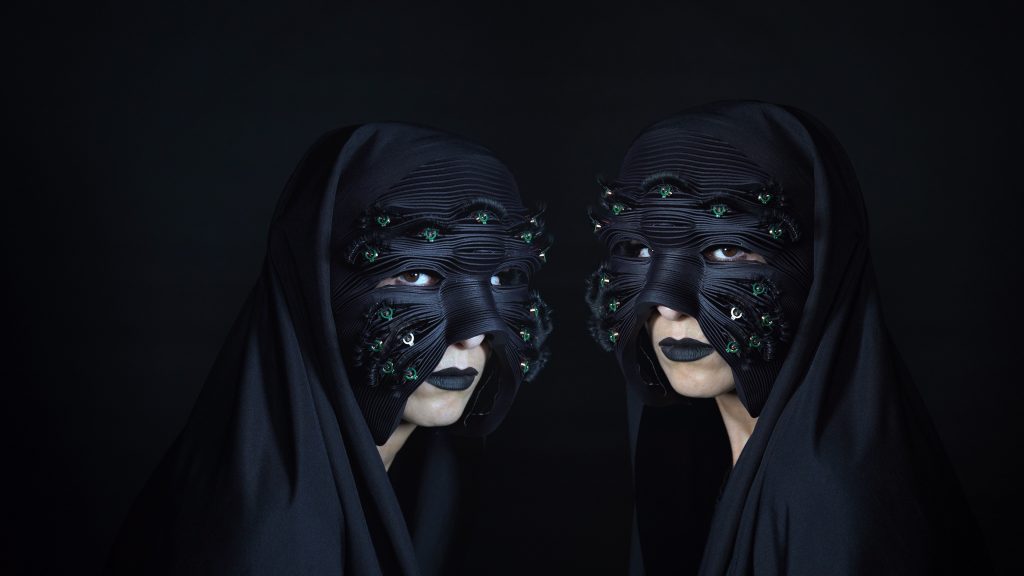
本計畫靈感來自伊朗南部 Bandari 女性佩戴的神秘歷史面具。傳說這些面具源自葡萄牙殖民時期,為了避免奴隸主尋找貌美女子的凝視而發展而成;從當代角度來看,亦可被視為女性抵禦父權壓迫的方式。
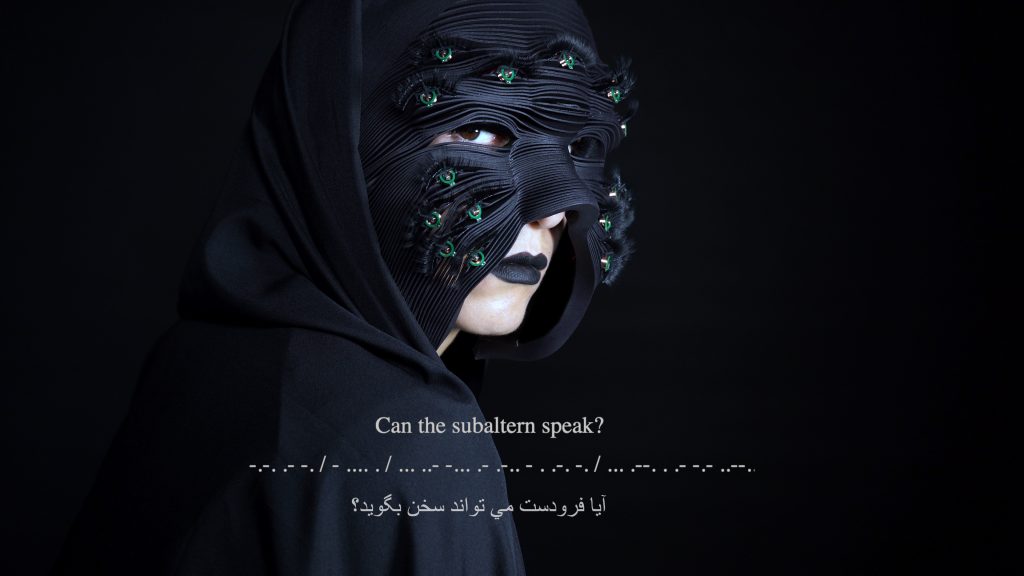
女性主義理論家 Gayatri Spivak 在其經典文章〈Can The Subaltern Speak?〉中,提出「在殖民壓迫下,底層是否能發聲?」的疑問。本計畫將此問題置於當代數位文化的脈絡:我們能否找到一種方式,使底層能發聲,並同時動搖壓迫者的權力?
在此作品中,兩副面具開始以自身的語言交流——透過 AI 生成的摩斯密碼,以快速眨眼的方式傳遞訊息。靈感來自幾個關鍵事件:兩個 AI 機器人發展出自身語言的案例;一名美國士兵在越戰被俘期間以摩斯密碼眨眼「TORTURE(酷刑)」;以及女性在 COVID-19 封鎖期間以隱晦手勢求助於家暴的事件。於此,性掠奪者的「眨眼」被轉化為抵抗語言,保護女性免於侵害。
作品意圖透過創造一種能讓壓迫者感到不安的新語言,動搖父權體系,同時為底層發聲。結合設計、批判思維、女性主義與 AI,本計畫挑戰歐洲中心的女性主義框架,並以前非西方視角為核心。
年份: 2021
媒材: 3D 列印、電磁致動器、機器人技術、微控制器
尺寸: 28 × 28 × 28 公分(11” × 11” × 11”)
This project is inspired by the intriguing historical masks worn by the Bandari women from southern Iran. Legend has it that these masks were developed during Portuguese colonial rule as a way of protecting the wearer from the gaze of slave masters searching for pretty women. Viewed from a contemporary perspective, they can also be seen as a means of shielding women from patriarchal oppression.
In her seminal article “Can The Subaltern Speak?”, feminist theorist Gayatri Spivak asks whether it might be possible for the colonized—the subaltern—to have a voice in the face of colonial oppression. How might we reframe this same question in the context of contemporary digital culture? How could we find a way for the subaltern to speak that would also undermine the power of the oppressor?
In this project, two masks begin to develop their own language to communicate with each other, blinking their eyelashes in rapid succession using AI-generated Morse code. The project draws upon moments such as the unnerving case where two AI bots developed their own language, an American soldier blinking “TORTURE” in Morse code during captivity in Vietnam, and stories of women using hidden signals to report domestic abuse during the COVID-19 lockdown. Here, the ‘wink’ of the sexual predator is subverted into a language of resistance to protect women from predatory advances.
The aim is to sow anxiety within the patriarchal system by developing a new language that unsettles the oppressor while giving voice to the subaltern. Bringing together design, critical thinking, feminism, and AI, the project challenges Eurocentric frameworks of feminist discourse by foregrounding a non-Western perspective.
Year: 2021
Media: 3D printing, elector-magnetic actuators, robotics, microcontroller
Size: 11”x 11” x 11”
若能真切「感受到」他人的凝視在自己身上,會是什麼樣的體驗?
女性在公共空間常遭遇不受歡迎的注視,這種騷擾根源於所謂「男性凝視」。 《凝視的撫觸》是一件回應此動態的可穿戴裝置:透過內建視覺技術,服裝能感知他人是否注視穿戴者,並即時回應——衣料表面隨之起伏、擴張或收縮。
這種轉化讓「凝視」不再隱形,而成為身體能直接感知的觸感。藉由將此互動具體化,作品挑戰我們對觀看、監視與欲望的想像。技術上,本作品透過 多材質 3D 列印 製作,並結合 電腦視覺 與 形狀記憶合金致動器(SMA),使衣料表面能隨旁觀者的凝視而動態變化。
《凝視的撫觸》並非將時尚視為單純裝飾,而是轉化為穿戴者與世界的主動介面。它提出疑問:科技如何幫助抵抗或重塑權力系統?設計如何將脆弱轉化為主體能動性?
年份: 2015
媒材: 多材質 3D 列印、機器人技術、微控制器
尺寸: 76 × 76 × 38 公分
What if you can feel someone’s gaze on your body?
Women often experience unwanted attention in public spaces, a form of harassment rooted in what has been called the “male gaze.” Caress of the Gaze is a wearable that responds to this dynamic. Using embedded vision technology, the garment senses when someone is looking at the wearer and reacts in real time—its surface ripples, expands, or contracts in response to the gaze.
This transformation makes the gaze tangible: no longer invisible, but something that can be felt directly on the body. By making this exchange physical, the project challenges how we think about looking, surveillance, and desire. Technically, the piece is multi-material 3D-printed and integrates computer vision with Shape Memory Alloy (SMA) actuators, which animate the surface of the garment in response to the onlooker’s gaze.
Rather than treating fashion as just decoration, Caress of the Gaze turns clothing into an active interface between the wearer and the world. It asks: How might technology help resist or reframe systems of power? How can design transform vulnerability into agency?
Year: 2015
Media: Multi-material 3D printing, robotics, microcontroller
Size: 76 * 76 * 38 cm
