Rewa Wright & Simon Howden
UnCalculated Studio(Rewa Wright & Simon Howden)
UnCalculated Studio 是由藝術家 Rewa Wright 與 Simon Howden 共同創立的創意夥伴計畫,兩人以大膽而出人意表的方式,融合科學、聲音與敘事。他們將從植物訊號到宇宙數據等各種素材,轉化為照亮公共空間、激發想像的大型數位藝術作品。
UnCalculated Studio 致力於創作具實驗性又兼具親和力的數位藝術,連結社群、宇宙與我們所處的生態系。其代表作品曾於世界各地的重要藝術節與展演空間展出,包括奧地利的 Ars Electronica、墨爾本的 Federation Square 4K 數位螢幕、Collingwood Yards(受邀參與 2024 年墨爾本藝穗節與投影藝術中心駐村)、洛杉磯的 SIGGRAPH(2023)、Vivid Sydney、布拉格劇場四年展(2023)、以及澳洲 Bunjil Place 藝術中心(2024)等地。
UnCalculated Studio is the creative partnership of Rewa Wright and Simon Howden, two artists who bring science, sound, and storytelling together in bold and surprising ways. We transform everything from plant signals to cosmic data into large-scale digital artworks that light up public spaces and capture the imagination.
UnCalculated Studio has built a reputation for creating accessible, experimental digital artworks that connect communities to both the cosmos and the living ecologies around us. We have had key artworks exhibited in prominent festivals and locations worldwide, such as Ars Electronica (Austria), Federation Square Digital 4K Screen (Melbourne), Collingwood Yards (for Melbourne Fringe and Centre for Projection Art Residency 2024), SIGGRAPH (Los Angeles 2023), Vivid Sydney, the Prague Quadrennial (2023), and Bunjil Place Arts Centre (2024).
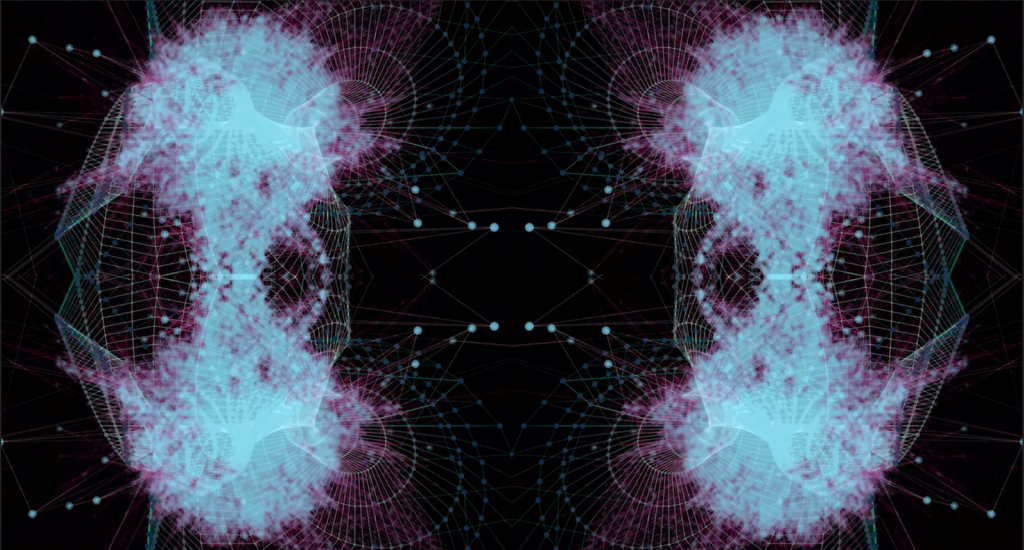
《Biorhythms》是一件互動藝術,將植物的生物電活動轉譯為即時聲音與動畫,並與 Simon Howden 的人類音樂融合。透過感測器與客製化軟體,作品揭示植物生命中隱藏的節律,轉化為不斷演化的聲音與視覺圖案。植物在此被視為共同作曲者,其訊號塑造出沉浸式體驗,邀請觀眾調頻於超越人類的生命力。作品借鏡後人類主義與生態視角,挑戰人類中心的科技觀,強調關係性與互動生成。這是一個美學與倫理並行的姿態,開啟人、機器與植物共創未來的詩意場域。
年份: 2024
媒材: 錄像
尺寸: 1920 x 1080
Biorhythms is an interactive artwork that translates the bioelectrical activity of living plants into real-time sound and animation, mixing these sonic visualizations with human composed music by Simon Howden. Using sensors and custom software, the piece
reveals hidden rhythms of vegetal life, transforming them into evolving sonic and visual patterns. Plants are positioned as co-composers, their signals shaping an immersive experience that invites audiences to attune to more-than-human vitality. Drawing on posthumanist and ecological perspectives, Biorhythms challenges anthropocentric views of technology, emphasizing relationality and intra-action. It operates as both an aesthetic and ethical gesture, opening poetic space for reflection on how humans, machines, and plants co-create shared futures.
Year: 2024
Media: video
Size: 1920 x 1080


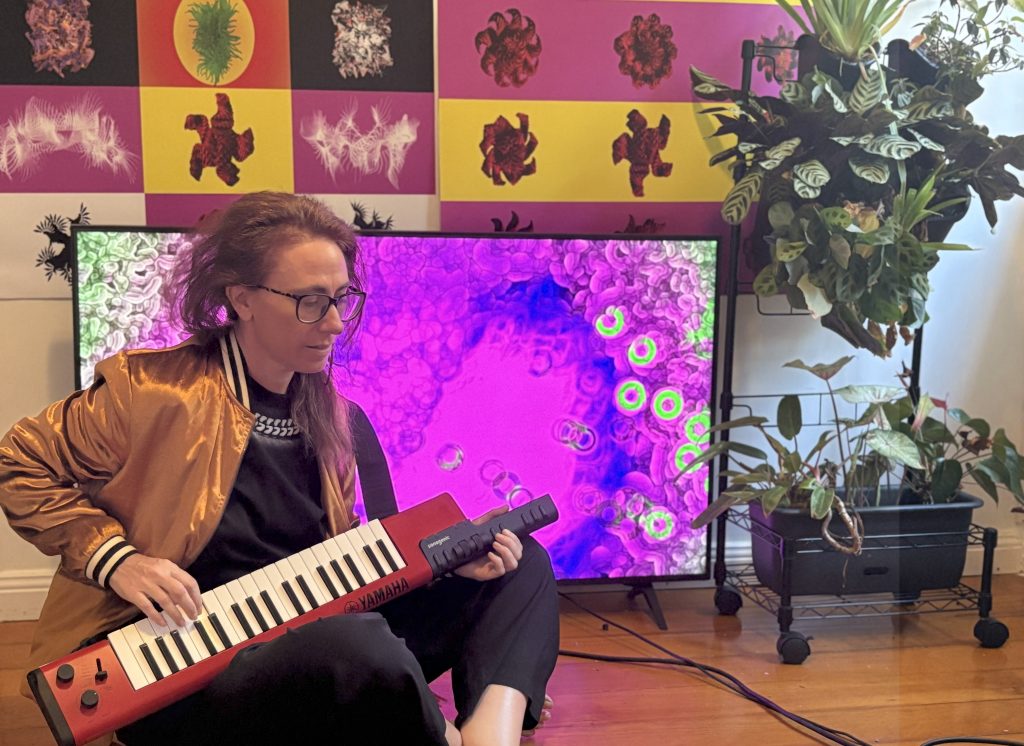
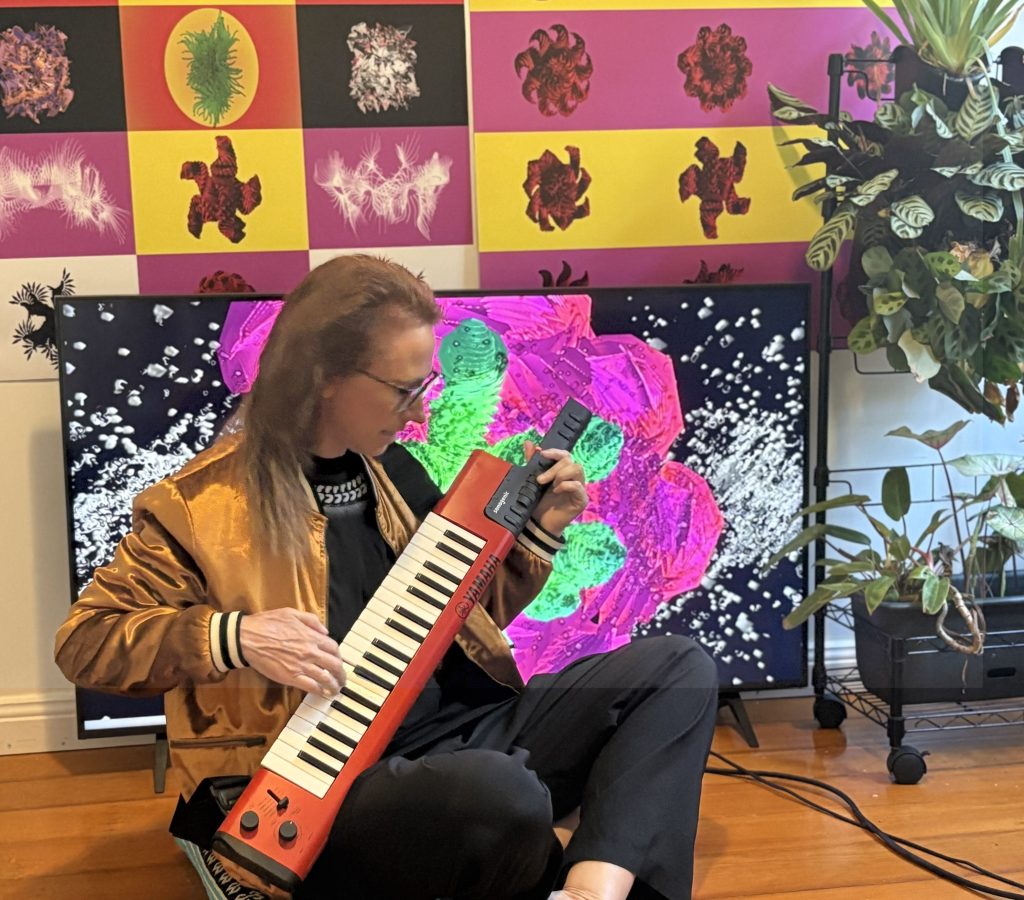
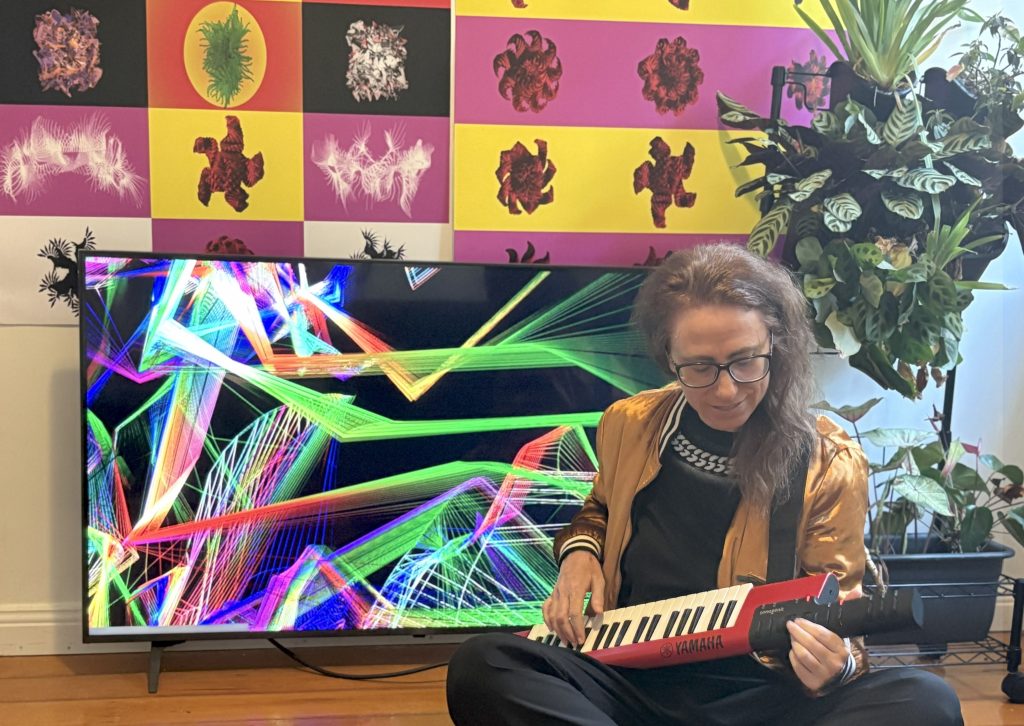
《Between Species》(2025)是一件互動裝置,將植物重新定位為積極的共同作曲者,而非被動的背景物質。作品實踐了後人類主義倫理,呼應 Rosi Braidotti 的「zoe 中心」哲學,凸顯超越人類的生命力與能動性,邀請觀眾進入跨物種的感知場域。植物、人類與機器形成一個活的回饋迴路,聲音與視覺輸出來自與植物生物電訊號的即時互動。
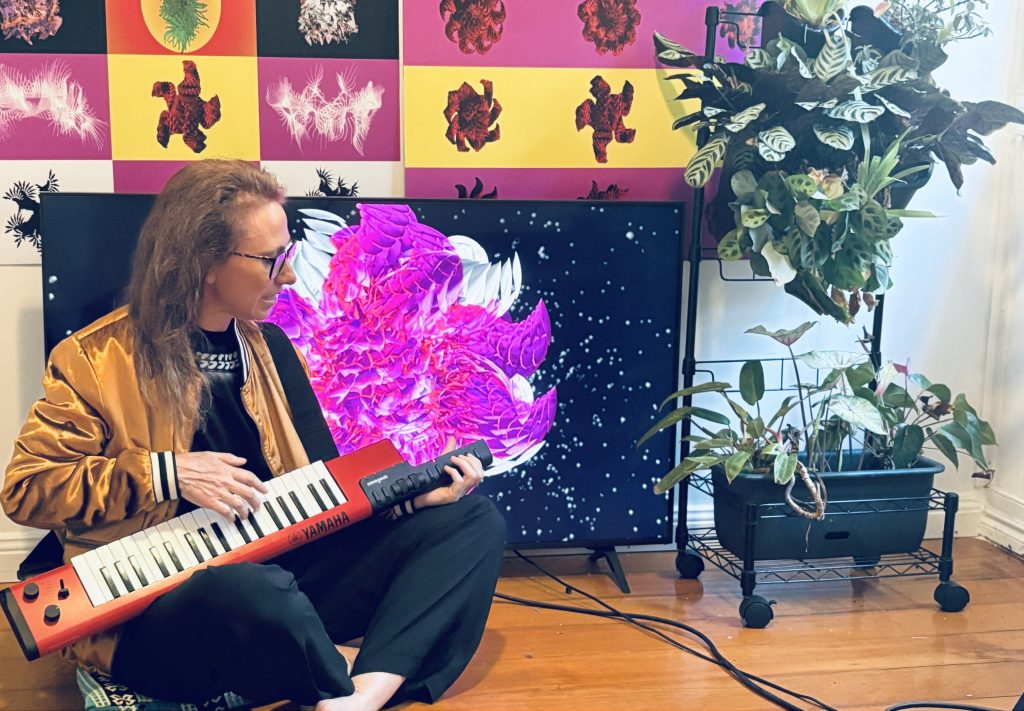
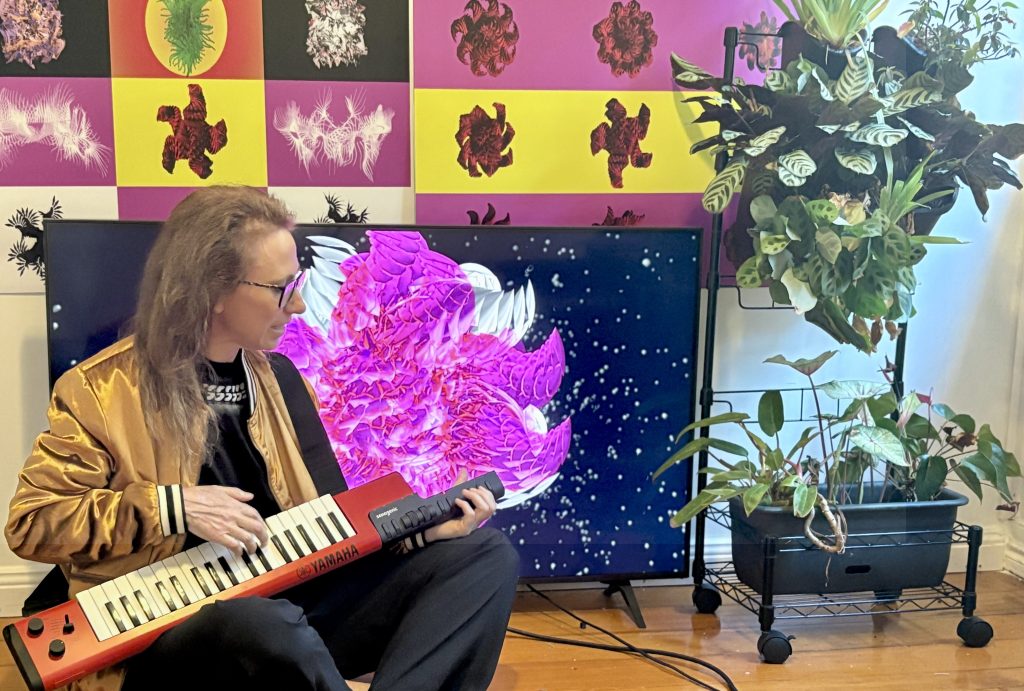
該裝置是一種非頭戴式的 XR 體驗,同時也是重新想像的樂器。一位參與者操作 Yamaha keytar,透過客製 MIDI 介面觸發聲音與影像序列;另一位則直接與植物互動,以觸碰或懸停的方式即時調變其生物數據。這些糾纏的輸入生成不斷變化的聲光場域,在秩序與不可預測之間擺盪,由客製軟體將植物電脈轉譯為沉浸式的聲光形態。
《Between Species》不是模擬自然,而是與自然共演。作品挑戰掠奪式邏輯,提出一種共作的推測性生態,將植物視為親緣而非素材。在這個共鳴空間中,物種界線消融於頻率、動作與振動,邀請我們以不同方式聆聽,並帶著關懷。
年份: 2025
媒材: 互動客製軟體(Touch Designer)、渲染影片、MIDI 網路、電容感測器、Yamaha Keytar、活體植物
尺寸: 依場地而定
Between Species (2025) is an interactive installation that repositions plants not as passive background matter but as active co-composers in an aesthetic assemblage. Enacting a posthumanist ethics aligned with Rosi Braidotti’s zoe-centred philosophy, the work foregrounds vitality and agency beyond the human, inviting audiences into a space of interspecies attunement. Plants, humans, and machines form a living feedback loop, where sonic and visual outputs emerge from real-time interactions with bio-electrical plant signals.
The installation is non-headset-based XR and doubles as a newly imagined musical instrument. One participant activates a Yamaha keytar, triggering audio-visual sequences via a custom-built MIDI interface. Another engages directly with the plants, touching and hovering to modulate their bio-data in real time. These entangled inputs generate shifting fields of sound and light—oscillating between order and unpredictability—as custom software interprets electrical pulses from the plants and translates them into immersive sonic-visual forms.
Rather than simulating nature, Between Species collaborates with it. The work challenges extractive logics by offering a speculative ecology of co-composition, where plants are not content but kin. In this shared space of resonance, the boundaries between species dissolve into frequencies, gestures, and vibrations—inviting us to listen differently, and with care.
Year: 2025
Media: Interactive custom software ( Touch Designer), rendered video, MIDI network, capacitive sensor, Yamaha Keytar, living plants.
Size: Size subject to venue conditions
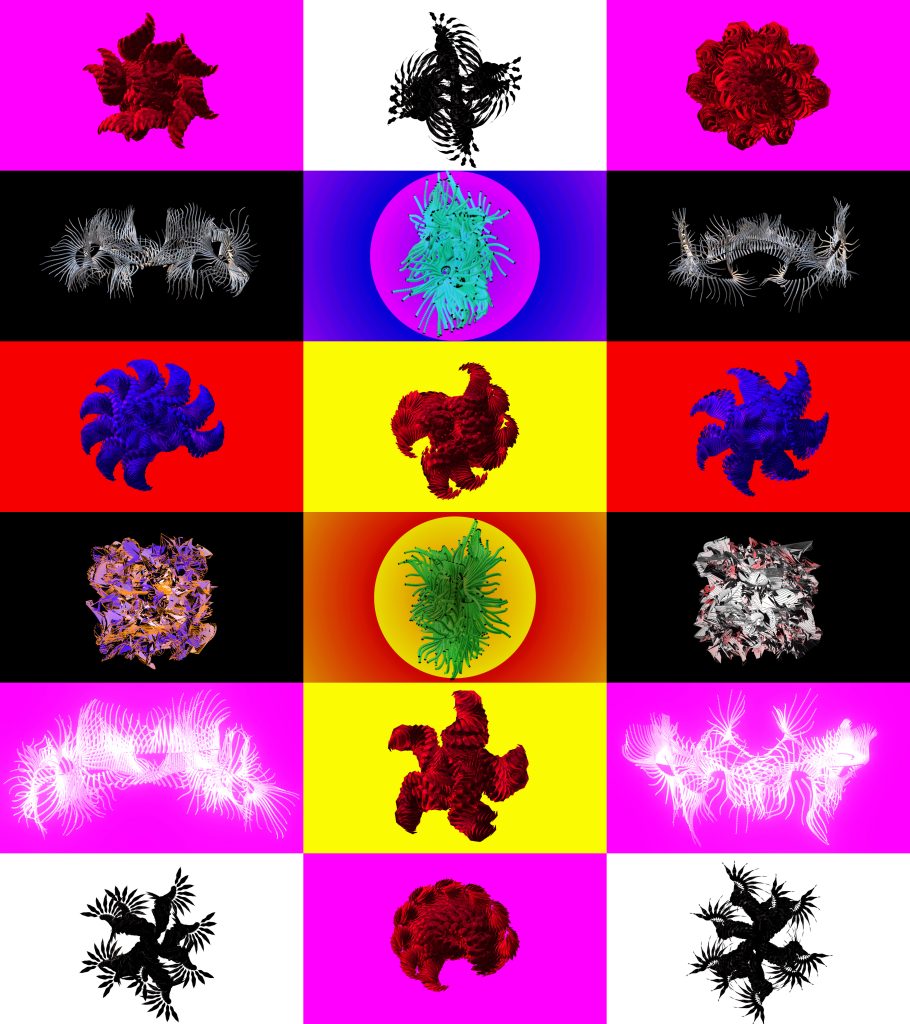
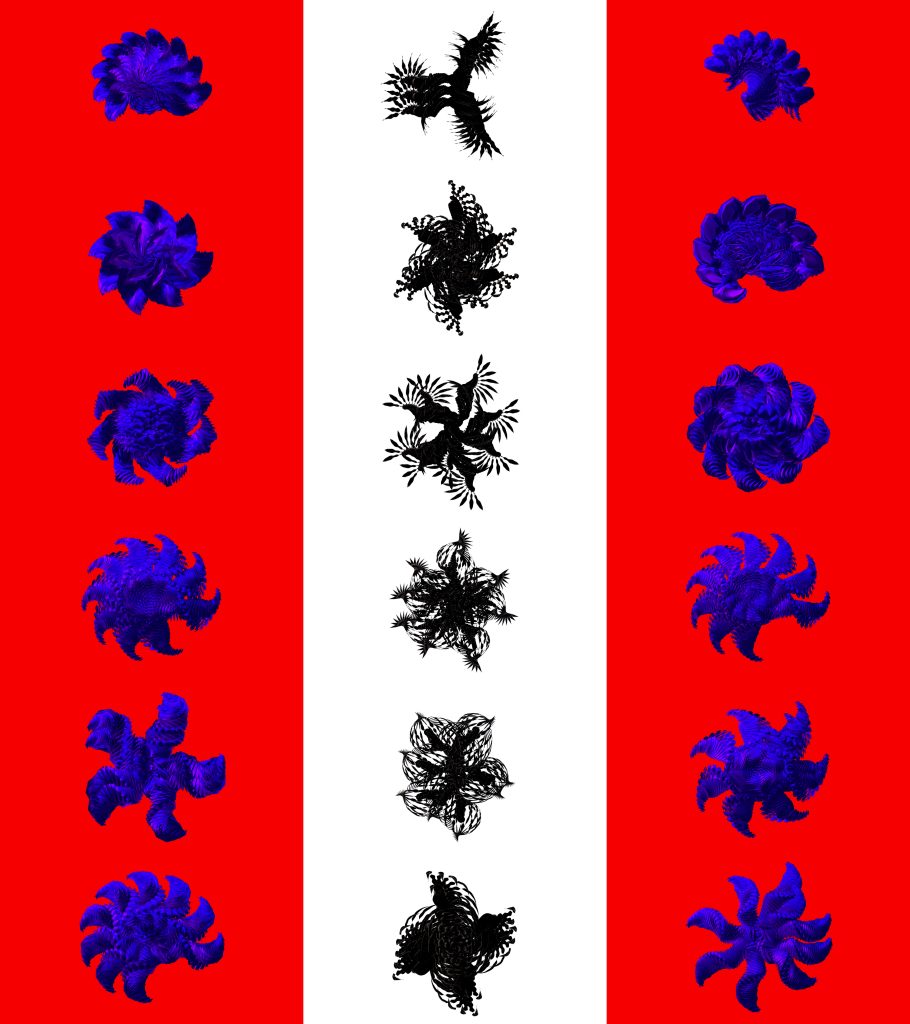
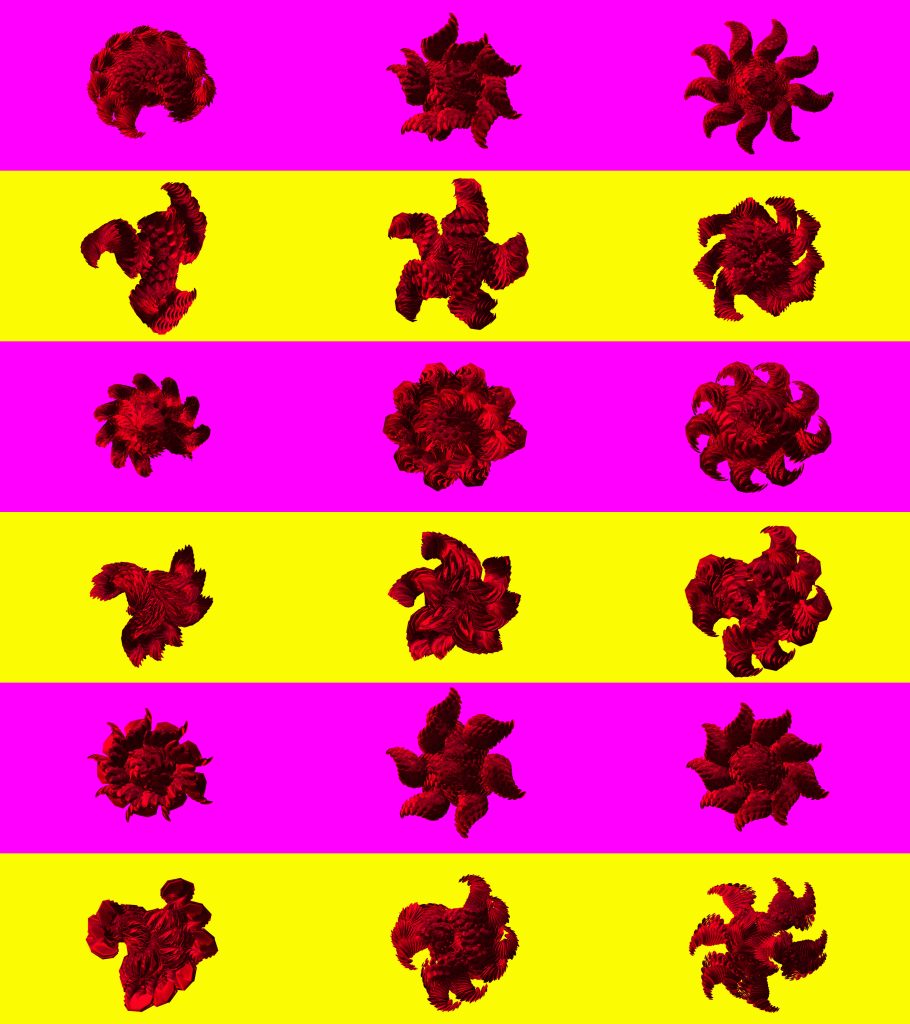
《仿生》(Biomimicry)是一組由 Touch Designer 生成的三件海報系列,將數學抽象轉化為重新想像自然設計智慧的媒介。根植於仿生學原理,每件作品探討形式系統——遞迴、對稱、葉序與參數化生長——如何展現自然形態生成中內建的迭代邏輯。系列不僅模仿外觀,而是挖掘計算數學與生物過程間更深層的結構親緣。
在視覺上,三聯畫分別呈現三種不同的關係邏輯:模組化多樣性、軸向對稱與色彩節律。它們共同暗示仿生學不僅是一種美學策略,更是一種與複雜性、湧現與共同進化相契合的哲學取向。系列作品因此思考「與自然共同創造」的意涵,而非僅是「關於自然」——讓程式、色彩與運算與超越人類的生成智慧進行對話。
三聯畫的中間一張海報同時包含了一首詩《島之歌》(Song for an Island)。這首詩由 Rewa Wright 與 Claude.ai 透過共創流程共同完成,過程中 Rewa 以自身的仿生系列作品(在 Touch Designer 中創作,未使用 AI)作為影像資料集。詩作取材於古典五言絕句形式,交織台灣的生態、文化遺產與自然象徵意涵。花開與山脈隱喻島嶼景觀,紅土喚起肥沃的耕地與滋養生命的土壤。白日十二道光芒成為循環更新的隱喻,既映照於自然生長模式,也映照於台灣國旗。最後,天際振翅的影子既呼應台灣珍貴的鳥類生態,也象徵自由與延續。整首詩引導觀者思考文化與自然如何共創台灣的未來,並藉由迭代性的共同創作探索人機協作的可能性。
年份: /
媒材:海報
尺寸: A1
Biomimicry is a three-poster series generated in Touch Designer, where mathematical abstraction becomes a medium for reimagining nature’s design intelligence. Rooted in the principles of biomimicry, each composition explores how formal systems—such as recursion, symmetry, phyllotaxis, and parametric growth—can express the iterative logic embedded in natural morphogenesis. Rather than mimicking appearances, the series engages deeper structural affinities between computational mathematics and biological processes.
Visually, the triptych stages three different relational logics: modular diversity, axial symmetry, and chromatic rhythm. Together they suggest that biomimicry is not just an aesthetic strategy, but a philosophical alignment with complexity, emergence, and co evolution. The series thus reflects on what it means to create with nature, rather than about it—placing code, colour, and computation in dialogue with the generative intelligence of the more-than-human world.
The middle poster of the triptych also contains a poem, Song for an Island. This was co created by Rewa Wright and Claude.ai through a co-design process of exchanging images and text, where Rewa’s biomimicry series (created without AI in Touch Designer), was uploaded as a visual dataset. The co-designed poem draws on the classical form of the wuyan jueju (five-character quatrain) to weave together Taiwan’s ecology, cultural heritage, and poetic natural symbolism. Blossoms and mountain veins evoke the island’s landscapes, while red earth recalls the arable land and the fertile soil that sustains life. The white sun with twelve rays becomes a metaphor for cyclical renewal, mirrored in natural patterns of growth and reflected in the national flag of Taiwan. Finally, wing-shadows across the sky speak both to Taiwan’s remarkable birdlife and to enduring freedom and continuity. Overall, this poem invites reflection on how culture and nature co-design Taiwan’s future, and through iterative co-creation explores the parameters of human machine creativity and collaboration.
Year: /
Media: poster
Size: A1
生形似花開
石脈引新枝
紅土孕生機
羽影織長空
Forms unfold like blossoms,
Stone veins guide new branches,
Red earth nurtures living energy,
Wing-shadows weave the vast sky.